
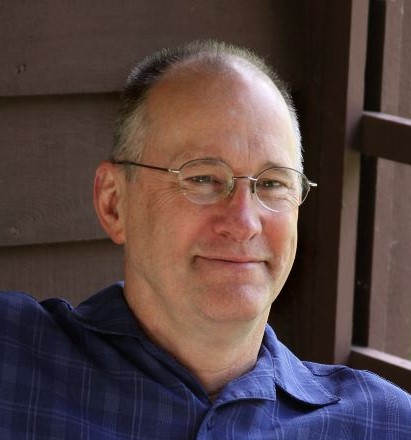
Joan and I were down at the farm last Saturday and a van pulled up to the house and a well-dressed young man carrying a large Bible emerged.
Joan said under her breath, “Uh, oh, this is going to be about religion.”
That’s like red meat to me, like throwing a dog a T-bone steak. I love it when people knock on my door wanting to discuss religion.
Joan hates it.
But we’d had a little argument that morning. She’d told me to stop eating so much ice cream, so I’d been thinking of ways to pay her back, and here was my chance.
The young man told us he was a Jehovah’s Witness and asked if we had a church home, I told him I was a Quaker pastor on the verge of retirement, that we’d be spending a lot of Sundays at our farm, and my wife had been looking for a local church. Talk to her, I said. Then I walked away.
I was maybe 18 when I visited a Kingdom Hall with a friend and thought for a few minutes of becoming a Jehovah’s Witness. But I was there just long enough to notice a pecking order, that older men were in charge and the women did what they were told to do. I’d had enough of that in the Roman Catholic Church, and was in no mood to see that again. I like my religion to be democratic. I don’t like ruling classes or hierarchies or dictatorships. I don’t think it’s healthy for children or other living things.
We’ve been talking about why war is not the answer. Thus far, we’ve said war is an enticing elixir, our national drug of choice for 235 of our 250 years. It is an addiction we seem unable and unwilling to break. Its casualties include not only those killed on the battlefield, but those who loved them. We’ve said war is the reason we can’t have nice things, the reason we lack universal healthcare, universal education, and universal childcare. It is the reason our infrastructure is in ruins. We’ve said war is started by the wealthy and powerful, but always at the expense of the poor and powerless. We’ve said war is nothing less than the organized abuse of children, that if an individual did to children what war did, they would go to jail. Last week, we said that just as young people are launching their lives, we bind and chain them to our foulest impulses, sending them forth to kill, because we, their elders, are not willing to do the difficult work of peace, reconciliation, and justice.
Today, I want to say that war, as it is usually practiced in the United States, is anti-democratic, contrary to the norms of democracy. America’s founders, having witnessed the autocratic power of kings, penned Article I, Section 8, Clause 11 of the Constitution, what became known as the War Powers Clause, giving Congress the power to declare war. This clause was intended to ensure that the decision to go to war was a collective, legislative decision rather than an executive one, made by one person. The stakes are too high and too significant for one person, no matter who they might be, to decide whether we will go to war.
Despite the clarity of the Constitution, the last U.S. president to seek congressional permission to go to war was Franklin D. Roosevelt at the start of World War II. Since then, U.S. presidents have circumvented the Constitution’s requirement of Congressional approval, which is our approval through our elected senators and representatives. Presidents disguised their treachery in semantics, claiming what they were doing was not a war, but a police action, an operation, a campaign, or a bombardment. But you know what, if it walks like a duck and quacks like a duck, it is probably a duck. But that isn’t true about war. President Truman called Korea a “police action.” Lyndon Johnson and Richard Nixon called Vietnam a “military action.” Ronald Reagan spoke of “peace through strength,” “initiatives,” “buildup,” and “containment.” George W. Bush and Barack Obama spoke of “operations” or “campaigns” to describe wars in Iraq, Afghanistan, and Libya. When the United States recently bombed Iran to assassinate its leader, Donald Trump and Pete Hegseth insisted it was not a war, but “an operation with clearly defined goals.” But Friends, if it walks like a duck and quacks like a duck, it’s probably a duck.
Each president insisted they were protecting our democracy, even as they flouted it. When was the last time you and I were given the opportunity to vote for a war or its funding? War, and the preparation for it, consumes 20% of our tax dollars, kills our citizens and the citizens of other nations, but we are given no say in the matter. Instead, one man starts a war with no input from anyone else.
Have you noticed how often presidents launch foreign wars when their domestic agenda is failing? If they can not exercise power on the home front, they exercise it on distant battlefields. Anything to strut and swagger, to flex their muscles, to project power.
This is especially frightening, given what we know about the psychological make-up of many presidents. Psychologists tell us they exhibit grandiose narcissism far out of proportion to the general public, characterized by attention-seeking, self-importance, and a high sense of entitlement—which allows them to believe, often inaccurately, that they are capable of achieving great things. They often possess an inflated need for admiration, and a lack of empathy, which is often manifested in manipulative and self-centered behaviors. I wouldn’t buy a car from a person like that, let alone put them in charge of the world’s largest military, yet we do it time and again. It helps me understand why we’ve been at war 235 of our 250 years. But after a while we must stop blaming the presidents who do this and start questioning the culture that grants men like that unchecked power.
Let this be the point of my message. At its heart, war is the enemy of democracy. It not only gives an outsized say to one person, those who should have a say, those who fight and pay and suffer for war, have no say at all. They are vassals serving a king. So after every war, there is a little less democracy.
I don’t want to brag about Quakers, well, maybe I do just a little bit. But in order for America to become a democracy there had to exist in our nation examples of democracy. At the start of our nation’s founding, at its very epicenter in Philadelphia, were a group of people whose rejection of hierarchy and embrace of democracy, exemplified a new and radical way of living together. So when our nation’s founders gathered to create our Constitution, they depended heavily upon the Constitution written by Quakers for the state of Pennsylvania. There’s a wonderful book called How the Quakers Invented America, written by the historian David Yount, which describes our influence.
This is to say that we Friends have invested heavily in the Constitution and are therefore obligated to speak up when it is abused, no matter the party abusing it. America’s Constitution is the secular expression of our sacred convictions. War is an affront to those convictions. It places power in the hands of a few, rejects the wishes of the many, all while denying the sanctity of human life. To be a Quaker is not only to love our fellow humans, it is to love democracy itself. It is to work together with all the world to achieve the Holy Perfection for which we yearn.